
Modern livestock operations, dairy farms, and biogas plants face strict environmental regulations regarding agricultural effluent and slurry management. Liquid manure, swine slurry, and anaerobic digestate are nutrient-rich organic fertilizers that, when applied correctly, significantly reduce a farm’s reliance on synthetic chemical fertilizers.
Deploying a mobile hose reel irrigator engineered for heavy fluids provides an efficient, automated method for distributing liquid organic waste across forage fields and pastures.
However, handling heavy livestock slurry requires specialized machine adaptations to prevent pipe clogging, pump cavitation, and premature corrosion.
This technical article details the engineering requirements for utilizing hose reel systems in agricultural wastewater and slurry disposal applications.
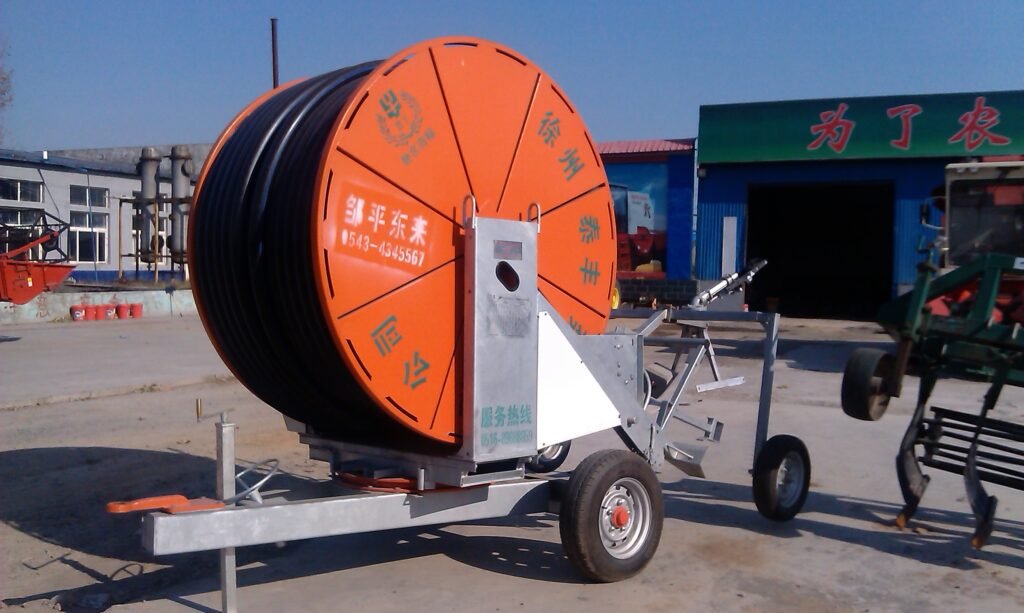
1. Machinery Adaptations for Handling Heavy Effluent
Pumping liquid manure and digestate introduces suspended solids, organic fibers, and corrosive chemical compounds that standard clear-water irrigators cannot handle.
Heavy-Duty Non-Clogging Drive Turbines
Standard water turbines can choke on thick slurry fibers. Slurry-spec hose reel irrigators utilize specialized open-impeller water turbines, heavy-duty hydraulic drive motors, or auxiliary engine drives that bypass solids without jamming internal gear mechanisms.
Internal Anti-Corrosion Coatings & Stainless Assemblies
Livestock effluent contains high concentrations of ammonia, nitrates, and organic acids. Key fluid-contact components—such as fluid swivel joints, cart manifolds, and fasteners—must be constructed from marine-grade stainless steel or protected by extra-thick hot-dip galvanization to prevent acid oxidation.
Large-Orifice Waste Rain Guns & Deflector Nozzles
Slurry spray carts deploy specialized rubber-lined or stainless waste guns fitted with large-diameter ring nozzles (22 mm to 34+ mm) and heavy-duty stream breakers designed to pass solid particles up to 15–20 mm without clogging.
2. Environmental & Agronomic Benefits
- Precision Nutrient Distribution: Automated retraction speed regulation ensures exact, uniform application depths ($m^3/hectare$), preventing localized nitrogen leaching into groundwater.
- Reduced Soil Compaction: Spreading liquid manure through a traveling hose reel eliminates the need for heavy tractor-towed slurry tankers to drive across wet pasture soils, preserving soil structure and protecting root health.
3. Operating & Maintenance Flushing Protocols
- Pre-Screening Slurry: Always pass raw pit effluent through a primary solids separator or chopper pump before pumping into the hose reel line.
- Post-Application Freshwater Purge: Immediately following a slurry spreading run, pump clean freshwater through the machine for 15–20 minutes to thoroughly flush all organic residue out of the PE pipe, turbine, and sprinkler cart.
Partner with HT Bauer for Slurry Management
Turn agricultural waste into valuable crop nutrients with heavy-duty effluent and slurry hose reel irrigators from HT Bauer. Our specialized equipment is engineered for extreme fluid environments, maximum corrosion resistance, and trouble-free operation.
Contact our environmental and agricultural engineering specialists today for a custom quote.
- Official Website: HT Bauer Irrigation Systems
- Sales Email: sunlei@htbauer.com | sunlei.htbauer@gmail.com
- Consultation: Request technical specifications for slurry and wastewater irrigators.