
On mobile hose reel irrigators utilizing long-range single rain guns, achieving uniform water coverage depends heavily on selecting the correct rain gun model, trajectory angle, and nozzle orifice size. The rain gun must throw water over wide strip widths (often 50 to 90+ meters) while breaking the water stream into uniform droplets across the entire throw radius.
Using an incorrect nozzle size or operating outside recommended pressure parameters causes poor application uniformity, leading to dry outer edges or localized soil erosion near the sprinkler cart.
This technical guide outlines best practices for rain gun selection, nozzle sizing, and trajectory adjustments for traveling irrigators.
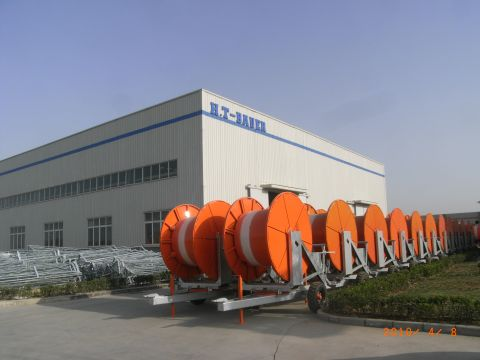
1. Key Performance Metrics for Heavy-Duty Rain Guns
Commercial agricultural rain guns feature specialized mechanical drive mechanisms designed to rotate smoothly under high water pressure.
- Slow Reverse Mechanism: Heavy-duty rain guns utilize slow-reverse drive arms or gear-driven rotation to eliminate mechanical vibration and lateral whip on the sprinkler cart frame during rotation direction changes.
- Interchangeable Main & Secondary Nozzles: Main stream nozzles handle long-range water throw, while adjustable secondary short-range nozzles fill in water application depth near the cart base.
- Adjustable Part-Circle Rings: Operators can set rotation arcs (e.g., 180° to 240° part-circle) to keep water throwing behind and to the sides of the cart, keeping the travel lane ahead dry for smooth PE pipe tracking.
2. Nozzle Sizing & Pressure Matching Guide
Nozzle orifice diameter directly dictates system flow rate ($m^3/h$) and required working pressure (bar):
| Nozzle Orifice Size (mm) | Recommended Operating Pressure (bar) | System Flow Rate Range (m3/h) | Effective Wetted Width (m) |
| 16 mm – 20 mm | 3.5 – 5.0 bar | $20 – 45\ m^3/h$ | 50 – 65 m |
| 22 mm – 26 mm | 4.5 – 6.5 bar | $45 – 75\ m^3/h$ | 65 – 80 m |
| 28 mm – 34+ mm | 6.0 – 8.5+ bar | $75 – 130+\ m^3/h$ | 80 – 95+ m |
Note: Operating a rain gun below its recommended pressure ceiling causes stream “ropey-ness” (large unbroken water streams that damage crops and soil), while over-pressurization atomizes droplets into fine mist susceptible to wind drift.
3. Managing Wind Drift & Trajectory Angles
In open windy environments, standard high-trajectory rain guns ($24^\circ – 28^\circ$) suffer high wind drift and evaporative losses.
- Low-Trajectory Options: In windy coastal or plain regions, deploy low-trajectory rain gun models ($18^\circ – 21^\circ$) to keep the water stream closer to the ground, preserving spray pattern integrity.
- Stream Breakers: Utilize adjustable stream-breaker screws on the nozzle tip to break up the water stream into finer droplets during early seedbed germination passes.
Partner with HT Bauer for Precision Sprinkler Packages
Achieving maximum water distribution uniformity requires expert matching between your hose reel irrigator, rain gun assembly, and pump pressure capabilities. HT Bauer provides industrial hose reel irrigators equipped with premium high-efficiency rain guns and custom nozzle sets tailored to your crop and field conditions.
Contact our sales and application team today to optimize your rain gun setup.
- Official Website: HT Bauer Irrigation Systems
- Sales Email: sunlei@htbauer.com | sunlei.htbauer@gmail.com
- Inquire Now: Request a rain gun nozzle performance chart and equipment quotation.