
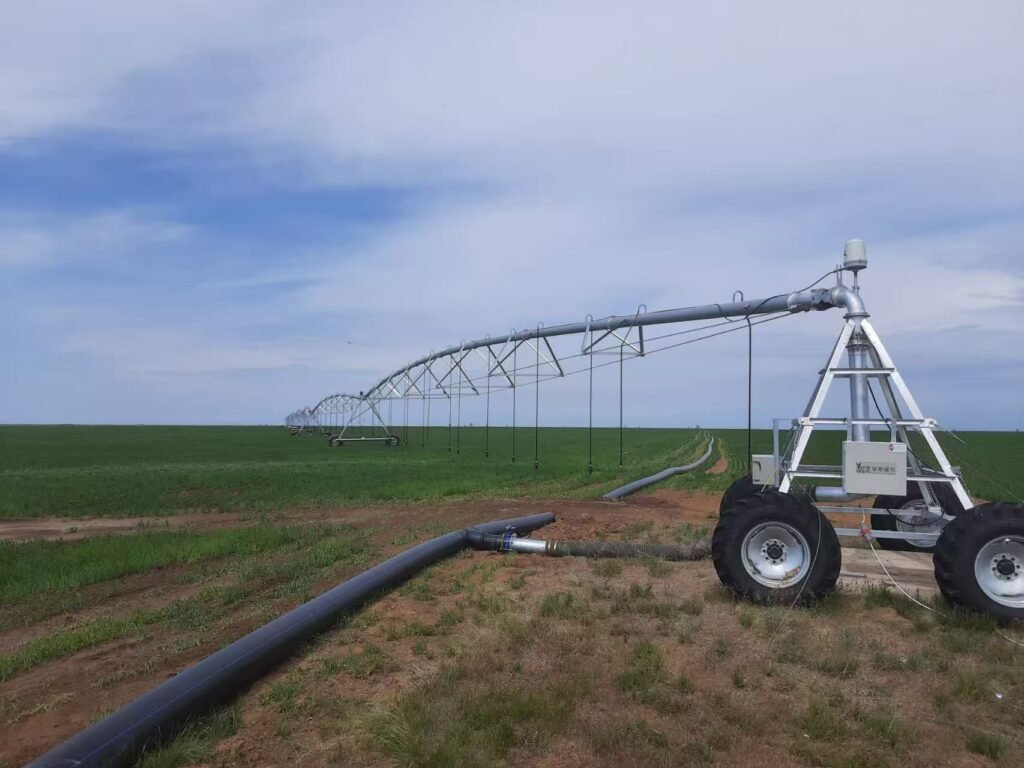
Agricultural operations in dryland and drought-prone regions face a constant challenge: maintaining profitable crop yields while managing strictly allocated or dwindling water supplies. In these demanding environments, Center Pivot Irrigation Systems have become an indispensable tool for commercial growers seeking to stabilize production, improve soil health, and protect their bottom line.
Beyond basic watering, center pivot technology gives producers precise control over field microclimates, moisture management, and soil salinity.
The Arid Land Challenge: Heat, Evaporation, and Salinity
Growing broadacre crops in arid or semi-arid zones presents distinct agronomic obstacles:
- High Evapotranspiration Rates: High ambient temperatures and low humidity accelerate water loss from both soil surfaces and crop canopies.
- Soil Salinity Build-Up: Inadequate or uneven leaching can cause mineral salts to accumulate in the root zone, stunting root development and lowering overall yield.
- Wind Drift: Traditional high-impact sprinklers lose a significant percentage of water to wind drift before droplets ever reach the canopy.
How Center Pivots Overcome Arid Farming Obstacles
1. Ultra-Low Evaporation with Drop Sprinklers
By utilizing flexible drop hoses that position sprinklers just 2 to 4 feet above the crop canopy—or below the canopy via Low Energy Precision Application (LEPA) dragged socks—center pivots apply water directly near the soil surface. This design shields water droplets from ambient heat and high winds, reducing evaporation losses by up to 95% compared to overhead impact guns.
2. Precise Moisture Management to Prevent Soil Crust & Salinity
Arid soils are often prone to surface crusting when heavy droplets compact the soil surface, preventing water infiltration and seed emergence. Center pivots deliver small, frequent applications of fine water droplets that maintain optimal soil moisture without destroying soil structure. Furthermore, precise application depth control enables planned leaching cycles to flush accumulated salts below the root zone without over-saturating the field.
3. Cooling Field Microclimates During Heat Waves
During extreme heat events, crops undergo severe thermal stress, causing stomata to close and stopping photosynthesis. Center pivots can be programmed to run quick, high-speed canopy-cooling passes. By applying a light mist across the crop canopy, ambient canopy temperatures drop significantly, preventing heat-induced blossom drop and preserving yield potential in high-value crops like potatoes, corn, and tomatoes.
4. Site-Specific Variable Rate Irrigation (VRI)
In large arid fields, soil water-holding capacity can vary drastically across different zones—from sandy patches that drain quickly to clay pockets that retain moisture. Modern center pivots equipped with VRI technology individually adjust nozzle duty cycles and travel speeds across each span section. This ensures every square meter receives the exact volume of water needed based on real-time soil moisture sensor data and field mapping.
ROI Analysis: Water Savings translated into Expanded Acreage
In many water-restricted districts, farm expansion is capped not by land availability, but by water rights volume.
By replacing flood, furrow, or traveling gun systems with center pivots:
- Water Consumption Efficiency: Improved from ~50% to 85%+.
- Pumping Power Savings: Lower operating pressures reduce generator and electricity expenses by 20% to 30%.
- Acreage Expansion: Saved water volume can often be reallocated to irrigate previously rainfed or fallow ground under existing water permits.
Sustainable Farming for the Future
For agricultural businesses operating under tightening environmental regulations and variable climate conditions, center pivot irrigation provides the reliability, control, and efficiency necessary to turn tough growing conditions into consistent, high-yield harvests.
🌾 Need an irrigation assessment for dryland or variable soils?
Reach out to our technical application engineers to calculate your potential water savings, required system friction heads, and custom nozzle package designs.