
Achieving peak yield and premium crop quality requires matching center pivot hydraulic performance with the specific root architecture, canopy growth patterns, and stress points of high-value cash crops. Unlike standard broadacre grains, cash crops like cotton, tomatoes, sugarcane, and soybeans demand tightly regulated soil moisture and specialized application techniques to maximize economic return per millimeter of water applied.
Below is an engineering and agronomic guide for customizing center pivot configurations across four high-value cash crop categories.
1. Cotton: Controlling Vegetative Growth & Boll Development
Cotton management relies on strict soil moisture control to balance vegetative growth with reproductive boll set.
- Agronomic Challenge: Excess water during early growth stages leads to rank (overly tall) growth and fruit shedding, while moisture stress during blooming and boll filling drastically reduces lint yield and fiber staple length.
- Pivot Configuration:
- Variable Rate Irrigation (VRI): Allows zone-specific application depths across varying soil textures, preventing over-watering in low-lying clay areas while maintaining moisture in sandy ridges.
- Chemigation & Growth Regulators: Integrated chemical injection systems allow precise application of plant growth regulators (PGRs) directly through the pivot canopy spray, maintaining ideal plant height without field traffic.
- Low-Pressure Canopy Drops ($0.7 \sim 1.0\text{ bar}$): Positions sprinklers below the top canopy line during mid-to-late season, directing water to the lower root zone while minimizing blossom wash and fiber contamination.
2. Processing Tomatoes & Root/Tubers: Preventing Disease & Fruit Cracking
Processing tomatoes and high-value root vegetables require precise moisture uniformity to prevent fruit splitting and fungal leaf diseases.
- Agronomic Challenge: Foliar wetness increases susceptibility to early/late blight and bacterial spot, while fluctuating soil moisture causes blossom-end rot and fruit cracking near harvest.
- Pivot Configuration:
- LEPA / Drop Hose Extensions: Flexible drop hoses lower sprinklers to $0.3 \sim 0.6\text{ meters}$ above the ground, delivering water straight to the soil bed beneath the thick leaf canopy to keep foliage dry.
- High-Uniformity Rotator Sprinklers: Multi-trajectory rotators prevent soil capping and bed erosion on raised planting beds, maintaining porous soil structure for healthy root expansion.
- Precise Stress Management Speed Programs: Advanced digital control panels enable automated fast passes during late ripening to dry down the field while maintaining minimal sub-surface root moisture.
3. Sugarcane: Navigating High Canopy & Heavy Water Load
Sugarcane requires massive volumes of water over an extended 12–18 month growing cycle, along with heavy-duty structural clearance.
- Agronomic Challenge: Extreme plant height (over 3–4 meters at maturity) creates severe canopy drag, while high water demand requires continuous heavy flow rates without structural sagging.
- Pivot Configuration:
- Ultra-High Clearance Spans: Specialized extra-tall tower structures provide maximum under-pipe clearance to navigate dense, tall cane stalks without causing mechanical bending or stalk lodging.
- Heavy-Duty Pipeline Sizing ($\varnothing 168\text{ mm}$ Pipe): Sizing the main pipeline to $6\ 5/8\text{ inches}$ ($\varnothing 168\text{ mm}$) supports continuous high-volume flow rates ($>300\text{ m}^3/\text{h}$) with minimal friction head loss, keeping pumping energy costs under control.
- High-Flotation Drive Towers: Equipped with reinforced wheel tower assemblies and wide-tread tires to handle wet, heavy soils during continuous irrigation cycles.
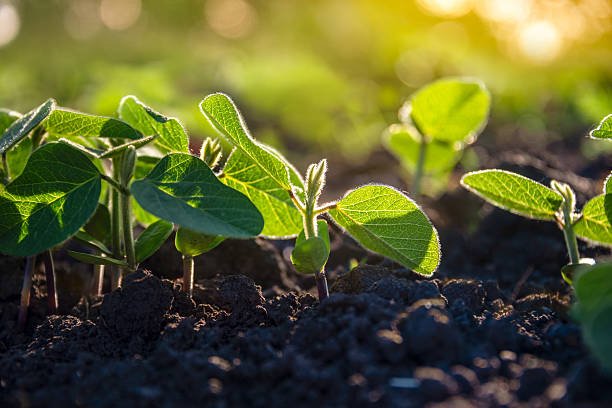
4. Soybeans & Legumes: Maximizing Pod Fill & Nitrogen Fixation
Soybeans require sustained soil moisture during pod development and seed filling to ensure high seed weight and oil content.
- Agronomic Challenge: Drought stress during flowering and pod fill causes flower abortion and small seed size, while waterlogging destroys beneficial root nodule nitrogen fixation.
- Pivot Configuration:
- Low-Pressure Rotator Packages ($1.0 \sim 1.5\text{ bar}$): Provides uniform, gentle water application that infiltrates deep into the root zone without sealing the soil surface or disrupting root nodule aeration.
- Spoon-Feeding Fertigation: Injects supplemental micronutrients (such as boron and manganese) during flowering and early pod development to maximize seed development.
- Automated Pressure Interlocks: Integrated pressure sensors automatically pause operation if system pressure fluctuates, ensuring that delicate pod canopies are never subjected to high-pressure water blasting.
Cash Crop Irrigation Engineering Matrix
| Cash Crop | Primary Yield Objective | Key Pivot Configuration Feature | Recommended Nozzle / Sprinkler Package |
| Cotton | Balanced vegetative growth & boll retention | VRI Control + Chemigation Modules | Low-Pressure Canopy Drops ($0.7 \sim 1.0\text{ bar}$) |
| Tomatoes / Root Crops | Splitting prevention & disease control | LEPA Drop Hoses + Bed Protection | Low-Pressure Rotator / Wobbler |
| Sugarcane | High volume delivery over tall canopy | High-Clearance Spans + $\varnothing 168\text{ mm}$ Pipe | High-Volume Top Spray Rotators |
| Soybeans | Maximize seed weight during pod fill | Precision Fertigation + Pressure Interlocks | Regulated Mid-Canopy Drops |
Custom Hydraulic Design for Your Farm
Every high-value crop project requires balancing soil infiltration rates, crop canopy traits, and total dynamic pump head. Tailoring your center pivot with crop-specific drop heights, pressure regulators, and automation tools ensures the highest return on investment per hectare.
🍅 Ready to optimize your pivot layout for high-value cash crops?
Contact our engineering application team with your crop rotation plan, field coordinates, and pump specifications for a customized hydraulic evaluation and system quotation!