
When investing in large-scale mechanized irrigation, farm owners and agricultural project developers must evaluate which technology delivers the highest return on investment (ROI) relative to land value, water availability, and field dimensions.
Center pivot irrigation systems and linear move irrigation systems are the two primary choices for automated overhead irrigation. While both systems use mobile steel spans and automated drive towers to distribute water, their structural movement, land coverage efficiency, and operational requirements differ fundamentally.
This comparative analysis evaluates the technical and financial trade-offs between linear move systems and center pivots to help you make an informed purchasing decision.
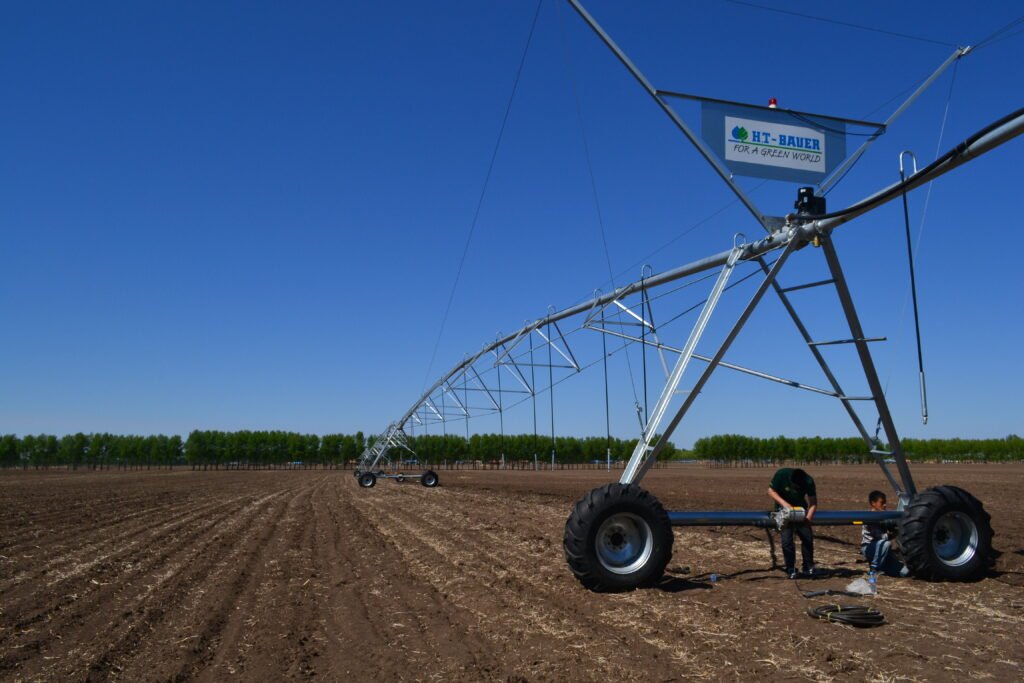
1. Fundamental Differences in Motion and Field Coverage
| Feature / Metric | Linear Move Irrigation System | Center Pivot Irrigation System |
| Motion Pattern | Straight-line lateral movement (back and forth). | Circular rotation around a fixed central pivot point. |
| Land Utilization | 100% Coverage: Fits rectangular and square plots perfectly. | ~78% Coverage: Leaves un-irrigated corners in square fields. |
| Water Inlet Point | Moving water supply (drag hose or open canal intake). | Fixed central point (underground mainline connection). |
| Field Geometry | Ideal for rectangular, long, and uniform field layouts. | Ideal for large, open, circular or square plots. |
| Capital Investment | Higher initial cost due to cart power unit & guidance. | Lower equipment cost per hectare in large circular fields. |
| Operational Labor | Low to Moderate (hose re-hookup or canal maintenance). | Extremely Low (fully automated fixed rotation). |
2. In-Depth Operational Comparison
Land Utilization & Crop Yield Impact
Land value is a major component of agricultural ROI. In a standard 64-hectare (160-acre) square field, a center pivot irrigates approximately 50 hectares, leaving 14 hectares in dry corners. A linear move system irrigates the entire 64 hectares. Where land cost, soil quality, or crop margins are high, capturing that additional 22% of cultivated area can significantly outweigh higher initial equipment costs.
Infrastructure & Water Supply Setup
- Center Pivots connect to a single, fixed point at the center of the field. Water mainlines, pumps, and power cables are routed directly to the pivot pad, simplifying piping infrastructure.
- Linear Move Systems require a continuous water feed along the full travel path. This requires either an underground mainline with hydrants spaced at regular intervals or a central concrete canal running parallel to the travel direction.
Energy Efficiency & Application Uniformity
Both systems utilize modern low-pressure spray packages (e.g., drop-hose wobblers and rotators operating at 1.0–2.0 bar). However, linear move systems maintain equal nozzle sizing and application rates across the entire span length because all towers travel at identical linear speeds. Center pivots require progressively larger nozzles toward the outer spans, as outer towers must travel faster to complete the circle.
3. Convertible & Towable Systems: Hybrid Operational Flexibility
To increase equipment utilization, modern linear move machines can be configured as towable or pivoting linear (swing-around) systems:
- Towable Linear Systems: The drive wheels can be rotated 90 degrees, allowing a tractor to tow the entire machine structure to an adjacent parallel field after completing a watering run.
- Swing-Around (Pivoting) Linear Systems: The machine functions as a linear irrigator down the field length, then automatically pivots 180 degrees around a end anchor to irrigate the adjacent field section on the return pass.
4. Decision Matrix: When to Choose a Linear Move System
Choose a Linear Move System if:
- Your land is rectangular, square, or high-value where every cultivated meter matters.
- You have an existing canal network or parallel underground supply pipeline.
- You need uniform drop-tube watering for row crops, vegetables, or forage.
Choose a Center Pivot System if:
- Your fields are large, open, and circular or near-circular in shape.
- Low labor intervention and simple single-point infrastructure are your top priorities.
Partner with HT Bauer for Advanced Field Engineering
Whether your agricultural operation requires maximum field coverage with linear irrigators or stationary center pivot solutions, HT Bauer provides tailored engineering expertise, structural reliability, and high-performance irrigation hardware.
Contact our technical sales engineers to run a field comparison and calculate the optimal ROI for your farm.
- Website: HT Bauer Official Site
- Email: sunlei@htbauer.com
- Consultation: Request a field assessment and customized equipment proposal.