
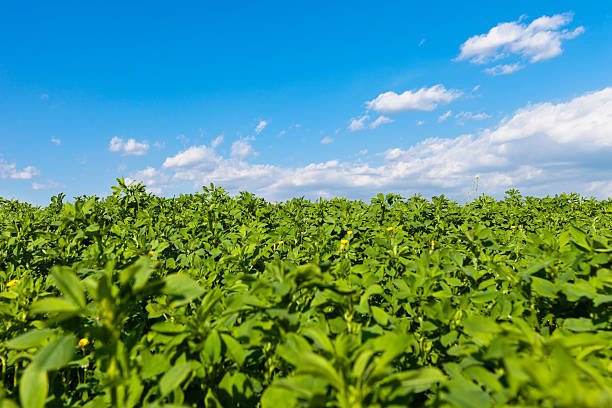
Often referred to as the “Queen of Forages,” alfalfa is a cornerstone of modern livestock, dairy, and hay production. Renowned for its high crude protein content and palatability, alfalfa requires substantial amounts of water to maintain high growth rates across multiple harvests (cuttings) per season.
Because alfalfa and pasture grasses are harvested continuously throughout the spring, summer, and autumn, irrigation schedules must be synchronized with cutting, wilting, and baling operations. This guide explores water management strategies for forage crops, equipment selection for commercial pastures, and soil trafficability preservation.
1. Water Requirements for Multi-Cut Forage Systems
Alfalfa has one of the highest seasonal water demands of any cultivated crop, consuming between 600 mm to over 1,200 mm of water annually depending on climate, soil type, and the number of seasonal cuttings.
Post-Harvest Re-growth Stimulation
Immediately following a cutting pass, the exposed plant crown requires quick, deep irrigation to trigger rapid vegetative regrowth. Delayed watering after harvest slows down recovery, reduces the total number of seasonal cuttings, and lowers total annual tonnage per hectare.
Managing Deep Root Moisture
Alfalfa possesses a deep taproot capable of extracting water from depths exceeding 1.5 to 2 meters. Maintaining a deep soil moisture reservoir allows the crop to draw water steadily between cutting cycles, preventing severe drought stress during peak mid-summer heat.
2. Equipment Selection for Commercial Pastures & Forage Farms
Hose Reel Irrigation Systems
Mobile hose reel irrigators are widely used in pasture and multi-plot hay operations due to their high portability. A single machine can irrigate a harvested pasture block, then be quickly towed by tractor to an adjacent field without interfering with active baling or grazing activities.
Linear Move & Center Pivot Systems
For large commercial hay farms operating on hundreds of contiguous hectares, high-capacity linear move or center pivot systems deliver continuous, automated coverage. Equipped with high-flotation tires and low-pressure drop nozzles, overhead spans cover vast pasture acreage at minimal labor cost.
3. Soil Compaction and Trafficability Management
A major challenge in multi-cut forage production is soil compaction caused by heavy tractors, balers, and haulage wagons traveling across wet fields.
- Irrigation Timing: Shut off irrigation well ahead of cutting passes to allow upper soil layers to dry sufficiently. This prevents deep wheel rutting, soil compaction, and root crown damage during harvest.
- Controlled Application Depth: Applying precise water quantities prevents standing surface water and minimizes runoff on sloped pasture lands.
Drive Your Forage Yields with HT Bauer Machinery
Maximizing dry matter tonnage and forage quality requires rugged, dependable irrigation equipment designed for frequent field moves and heavy seasonal use. HT Bauer provides heavy-duty hose reel irrigators, high-efficiency linear spans, and specialized pasture watering equipment engineered for commercial forage producers worldwide.
Contact our agricultural engineering team to discuss equipment configurations for your forage or livestock operation.
- Official Website: HT Bauer Irrigation Systems
- Sales Email: sunlei@htbauer.com | sunlei.htbauer@gmail.com
- Technical Support: Request a customized forage irrigation proposal and product catalog.