
Irrigation water is not always crystal clear. Many commercial farms draw water from open canals, rivers, agricultural drainage ditches, or farm ponds. While these sources provide abundant water volume, they also carry suspended silt, organic algae, aquatic weeds, sand particles, and fine debris.
When pumping unfiltered water through a hose reel irrigator, debris can cause severe operational problems: nozzle orifices clog (leading to uneven spray patterns), abrasive sand wears down turbine impellers, and organic matter scales internal pipe walls.
This technical guide explores essential filtration setups and anti-clogging management strategies for traveling irrigation systems.
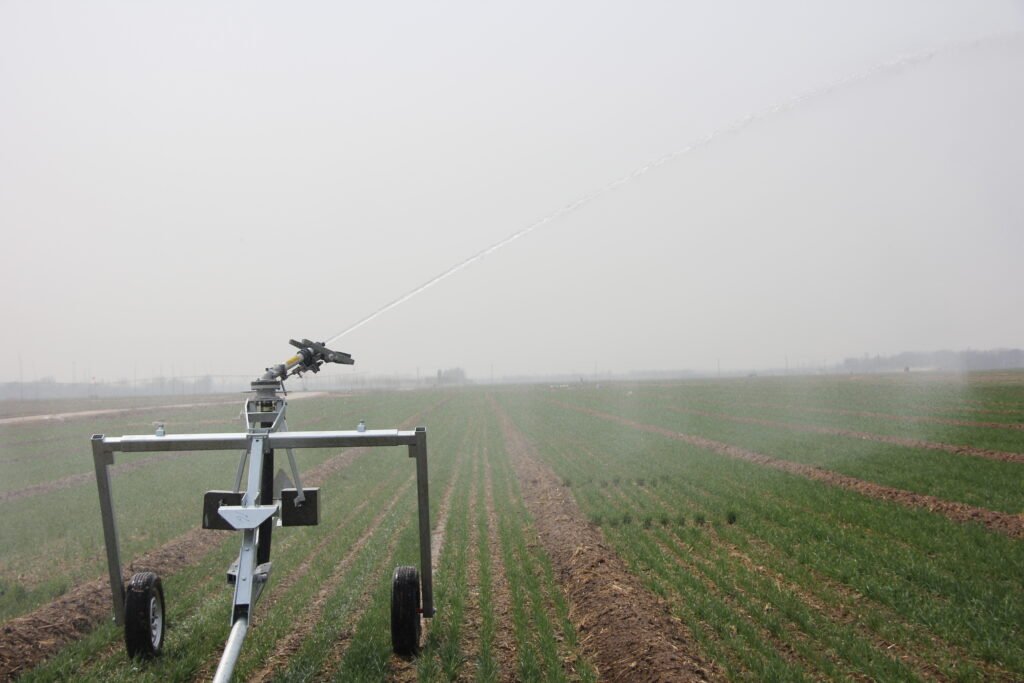
1. Essential Filtration Setup for Traveling Irrigators
Protecting your irrigation machinery from waterborne contaminants begins at the pump suction point and extends through the discharge line.
Floating Suction Strainers
When pumping from open ponds or rivers, never let the suction foot valve rest on the muddy bottom. Using a floating suction strainer suspends the intake 30 to 50 centimeters below the water surface, ensuring clean water entry while avoiding bottom silt, heavy gravel, and surface floating debris.
Primary Screen & Disk Filtration
Before water enters the high-density polyethylene (PE) supply hose, it must pass through a primary filtration station installed at the pump discharge:
- Disk Filters: Highly effective at trapping both organic material (algae) and inorganic particles (sand) through compressed grooved plastic disks.
- Screen Filters: Provide reliable filtration for general surface water sources, featuring easy manual or automated flushing mechanisms to clear trapped debris.
2. Protecting the Internal Water Turbine
The internal water turbine is the mechanical heart of a hose reel irrigator, utilizing pressurized water flow to drive the gearbox and retract the PE pipe.
- Impeller Protection: Suspended sand acts like liquid sandpaper on turbine blades. Effective upstream filtration prevents premature blade erosion and speed control calibration drift.
- Turbine Bypass Flushing: After completing an irrigation run—especially when pumping water with high sediment content—operators should flush the turbine housing and bypass valve to prevent mineral scaling and sediment buildup.
3. Nozzle Maintenance & Large-Passage Design
- Nozzle Inspection: Routinely check rain gun tips and boom spray nozzles for mineral deposits or trapped weed seeds.
- Selecting Anti-Clogging Nozzles: For open-source water applications, choose engineered spray nozzles with wide internal flow passages that resist minor debris accumulation without disrupting precipitation uniformity.
Partner with HT Bauer for Integrated Irrigation Engineering
Achieving trouble-free operation in challenging water conditions requires robust equipment design and proper filtration engineering. HT Bauer provides heavy-duty hose reel irrigators and expert guidance on matching pump sets and filtration systems to your specific water source.
Contact our engineering specialists today to optimize your irrigation water management.
- Official Website: HT Bauer Irrigation Systems
- Sales Email: sunlei@htbauer.com | sunlei.htbauer@gmail.com
- Consultation: Request technical advice on water filtration and equipment matching.