
In large-scale commercial farming and agricultural production, selecting the right mechanized irrigation technology is a critical strategic decision. Irrigation equipment represents a major capital investment that directly impacts water efficiency, labor costs, energy consumption, and crop yield across seasons.
Among modern mechanized irrigation methods, hose reel irrigators (traveling irrigators) and center pivot irrigation systems are two of the most widely adopted technologies globally. While both systems deliver automated, uniform water coverage, their operational designs, field adaptability, and capital requirements differ significantly.
This article provides an in-depth comparative analysis of Hose Reel Irrigators and Center Pivots to help farm managers, agricultural engineers, and project developers select the optimal system for their field conditions and budget.
1. Understanding the Systems
Before comparing performance metrics, it is essential to understand the structural layout and operating mechanics of each system.
Hose Reel Irrigation Systems
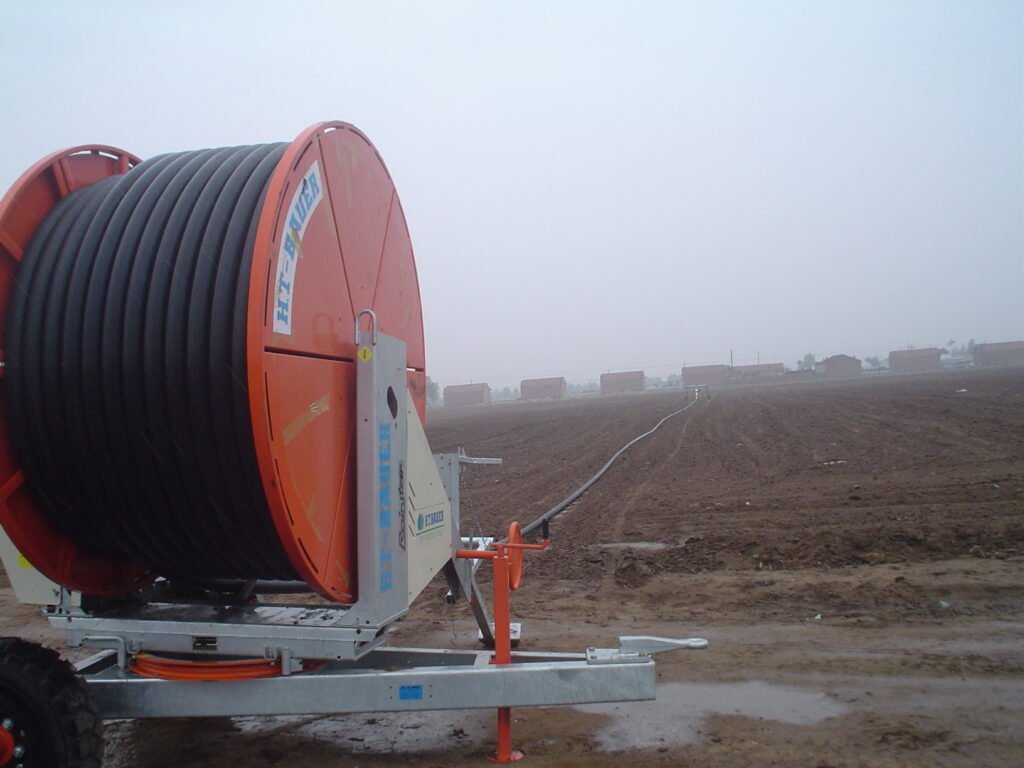
A hose reel irrigator is a mobile, self-contained irrigation machine consisting of a heavy-duty chassis, a large rotating drum spooled with high-density polyethylene (PE) pipe, an internal drive turbine or motor, and a mobile sprinkler cart equipped with a high-capacity rain gun or a foldable spray boom.
- Operating Principle: The tractor positions the machine at the edge or end of a field, and pulls the sprinkler cart across the lane. As water pressurizes the system, an internal water turbine drives the gearbox, automatically retracting the PE pipe and pulling the cart back toward the reel unit at a controlled speed.
- Structural Mobility: Highly portable and easily towed between multiple fields using a standard farm tractor.
Center Pivot Irrigation Systems
A center pivot system is a stationary overhead irrigation structure consisting of multiple steel or aluminum pipe spans connected by flexible joints and supported by wheeled drive towers. The system pivots around a central fixed point (pivot point) where water and electrical power are supplied.
- Operating Principle: Electrically powered drive wheels at each tower continuously rotate the entire span structure in a circular motion around the pivot anchor, delivering water continuously through sprinklers positioned along the pipeline.
- Structural Mobility: Primarily stationary, requiring permanent concrete foundations and dedicated underground water mains (though towable pivot variants exist for adjacent parallel fields).
2. Head-to-Head Comparison: Hose Reel vs. Center Pivot
Evaluating key operational parameters highlights where each system excels.
| Feature / Metric | Hose Reel Irrigation System | Center Pivot Irrigation System |
| Initial Capital Investment | Lower initial equipment cost per machine. | Higher upfront infrastructure and installation cost. |
| Field Shape Adaptability | Extremely Flexible: Fits rectangular, square, long-strip, and irregular plots. | Best for Large Circles: Leaves field corners un-irrigated (unless equipped with corner arms). |
| Mobility & Multi-Field Use | High Mobility: One machine can irrigate multiple separate fields. | Stationary / Fixed: Tied to a specific installation site and permanent anchor point. |
| Installation Requirements | Minimal; minimal civil works or permanent piping needed. | Substantial; requires concrete pivot pad, electrical line run, and underground supply pipes. |
| Labor Requirement | Moderate; requires tractor transport and setup between runs. | Extremely Low; fully automated and programmable via remote control/telematics. |
| Energy & Pressure Needs | Medium to High (typically 4.0–8.0+ bar depending on nozzle/boom). | Low to Medium (designed for low-pressure drop-down nozzles, 1.5–3.5 bar). |
3. Key Decision Factors for Farm Selection
Field Topography, Geometry, and Land Boundaries
- Irregular and Divided Plots: Hose reel irrigators excel in fields with irregular boundaries, obstacles (trees, utility poles), divided plots, or narrow rectangular layouts where installing a circular pivot path is impossible or cost-prohibitive.
- Large Continuous Fields: Center pivots are ideal for expansive, unobstructed circular or near-circular land plots (e.g., 40 to 100+ hectares per circle) where continuous rotation maximizes efficiency.
Capital Allocation & Return on Investment (ROI)
- For medium-sized operations, rented farmland, or farms expanding irrigation in phases, hose reel irrigators offer a significantly lower entry cost and immediate operational flexibility.
- For large-scale corporate farms with long-term land ownership and fixed infrastructure budgets, center pivots provide low long-term labor costs and highly automated irrigation scheduling.
4. Sprinkler Boom Attachments: Elevating Hose Reel Efficiency
A common consideration when evaluating hose reel irrigators is water droplet size and operating pressure. Traditional long-range rain guns operate at higher pressures and can produce larger water drops.
To achieve the low-pressure, high-efficiency micro-sprinkling benefits of a center pivot, hose reel irrigators can be equipped with a foldable sprinkler boom (truss boom):
- Low Operating Pressure: Operates effectively at reduced inlet pressures (as low as 2.0–3.0 bar), cutting energy and pumping costs.
- Delicate Crop Protection: Uses precise low-drift nozzles that produce gentle spray patterns, ideal for seedlings, leafy vegetables, onions, and delicate cash crops.
- Soil & Wind Protection: Low-clearance drop sprays minimize wind drift and prevent soil crusting or erosion.
5. Technical Pre-Purchase Checklist
When evaluating either system for your agricultural operations, review the following technical parameters with your irrigation supplier:
- Water Source Hydraulics: Available static/dynamic pressure (bar) and continuous flow rate ($m^3/h$).
- Field Topography & Soil Type: Slope percentage, elevation changes, and soil infiltration rates.
- Power Availability: Proximity to three-phase grid power vs. diesel/tractor PTO pumping setups.
- Crop Rotation Strategy: Multi-crop seasonal movement vs. fixed single-crop acreage.
Partner with HT Bauer for Custom Irrigation Solutions
Whether your farm requires high-mobility hose reel irrigators or comprehensive field irrigation planning, HT Bauer delivers heavy-duty, industrial-grade agricultural equipment tailored to complex field conditions worldwide. Our engineering team provides detailed flow calculations, system sizing, and equipment matching to maximize your yield per drop.
Contact our agricultural engineering specialists today to request technical advice or a customized quotation.
- Website:HT Bauer Official Site
- Email: sunlei@htbauer.com
- Consultation: Request a field assessment and equipment proposal.