
When selecting a Center Pivot Irrigation System for large-scale agricultural operations, there is no “one-size-fits-all” configuration. Field geometry, soil infiltration rates, water source connection pressure, and peak crop water requirements directly dictate the selection of span lengths, pipe diameters, and sprinkler packages.
A scientifically matched system configuration not only maximizes water application efficiency (saving up to 30% water) but also reduces pumping station power consumption and ensures long-term operational reliability. Below are the 4 critical engineering dimensions evaluated when designing an optimal center pivot layout:
1. Pipe Diameter Selection: Balancing Friction Loss and Pumping Energy
The main pipeline of a center pivot acts as the primary water conduit. Selecting the correct outer pipe diameter directly impacts friction head loss and the required operating pressure at the pivot point:
- Standard Diameter Options: Available in $\varnothing 133\text{ mm}$ ($5\text{ inches}$) and $\varnothing 168\text{ mm}$ ($6\text{ 5/8 inches}$) pipeline configurations.
- Application Guidelines:
- Compact/Small Parcels: For smaller coverage areas (such as 15 to 20 hectares) requiring lower flow rates ($96.9 \text{ m}^3/\text{h} \sim 124.3 \text{ m}^3/\text{h}$), the $\varnothing 133\text{ mm}$ pipe reduces upfront equipment capital investment while maintaining optimal hydraulic pressure (2.8 to 3.1 bar).
- Broadacre Operations: For long-span, high-flow systems (covering over 50 hectares with flow rates exceeding $200 \text{ m}^3/\text{h}$ up to $430 \text{ m}^3/\text{h}$), a larger $\varnothing 168\text{ mm}$ pipeline is essential. The larger cross-sectional area minimizes internal water flow velocity and friction resistance, significantly lowering pump pressure requirements and reducing electricity costs over years of operation.
2. Span Structure and Overhang Design: Adapting to Topography and Field Borders
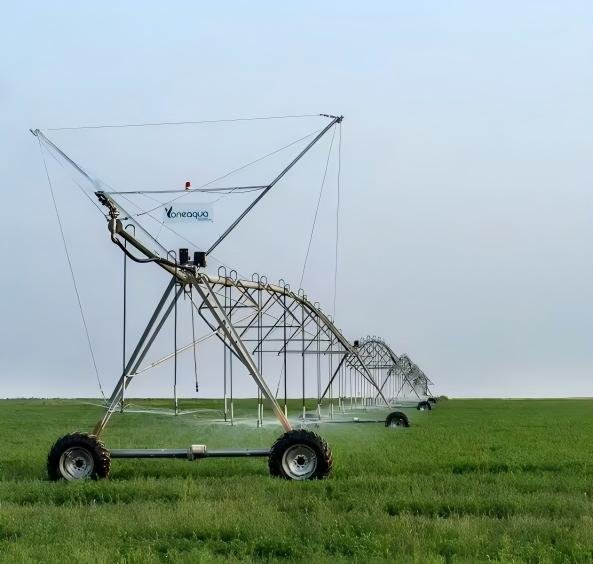
A center pivot structure consists of a fixed central pivot tower, multiple hot-dip galvanized steel truss spans, and an optional end overhang.
- Flexible Span Combinations: Span lengths can be customized between 40 meters and 60 meters to fit varying parcel boundaries. High-strength structural trusses and flexible joint couplers comfortably accommodate terrain undulating up to $\pm15\%$ slope, eliminating the need for expensive land leveling.
- End Overhang & End Gun: Adding an end overhang pipe extension and a high-pressure end gun beyond the last wheel tower increases the irrigation radius by an extra 10 to 15 meters, maximizing crop coverage in hard-to-reach field corners without requiring extra drive tower assemblies.
3. Sprinkler Package Engineering: Matching Soil Infiltration Rates
Selecting the proper nozzle package determines how water droplets interact with the soil. If the application rate exceeds the soil’s natural intake capacity, water runoff and soil compaction occur:
- Low-Pressure Rotators: Operating at low connection pressures ($0.7 \sim 2.0\text{ bar}$ at the nozzle), low-pressure sprinklers deliver uniform droplet distribution while minimizing droplet drift and evaporation losses compared to old high-pressure impact sprinklers.
- Drop Hoses (LEPA/LESA): Utilizing flexible drop hoses positions sprinklers $0.5 \sim 1.2\text{ meters}$ above the crop canopy, shielding water from wind drift and boosting water application efficiency to $85\% \sim 95\%$.
- Progressive Nozzle Sizing: Because outer drive towers travel faster than inner spans, nozzle orifices must progressively increase in size from the central tower outward, ensuring a uniform application depth (Uniformity Coefficient $>90\%$) across every square meter of the field.
4. Drive Train and Smart Control Systems: Securing Continuous Operation
- High-Torque Drive Motors & Gearboxes: Heavy-duty electric drive motors paired with high-ratio gearboxes and wide-profile, high-flotation tires deliver reliable traction through wet, muddy conditions and deep field ruts.
- Safety Alignment & Pressure Monitoring: Modern systems continuously track system line pressure via pressure sensors and monitor tower alignment. Integrated safety interlock switches instantly shut down system power if a tower becomes misaligned or experiences a sudden pressure drop, protecting the steel truss structure from torsional damage.
Technical Selection Summary
Customizing an efficient center pivot system requires a comprehensive evaluation of field geometry, soil intake rate, crop water demands, and pump head/flow specifications. Proper engineering alignment delivers up to 30% water savings, lowers operating power bills, and delivers an accelerated capital return on investment (ROI).
💡 Need a custom hydraulic calculation or field layout proposal?
Contact our technical engineering team with your field CAD drawings or coordinates to receive a tailored, high-efficiency irrigation proposal!