
Maximizing crop yields on square and rectangular fields requires adapting irrigation hydraulics to the specific canopy architectures, root zone dynamics, and growth stages of your crops. Aqualine Linear Sprinklers (Lateral Move Systems) provide an ideal application platform because their uniform travel speed delivers an equal volume of water and nutrients across every row from edge to edge.
Below is an engineering and agronomic application guide for deploying Aqualine Linear Sprinklers across four distinct crop categories.
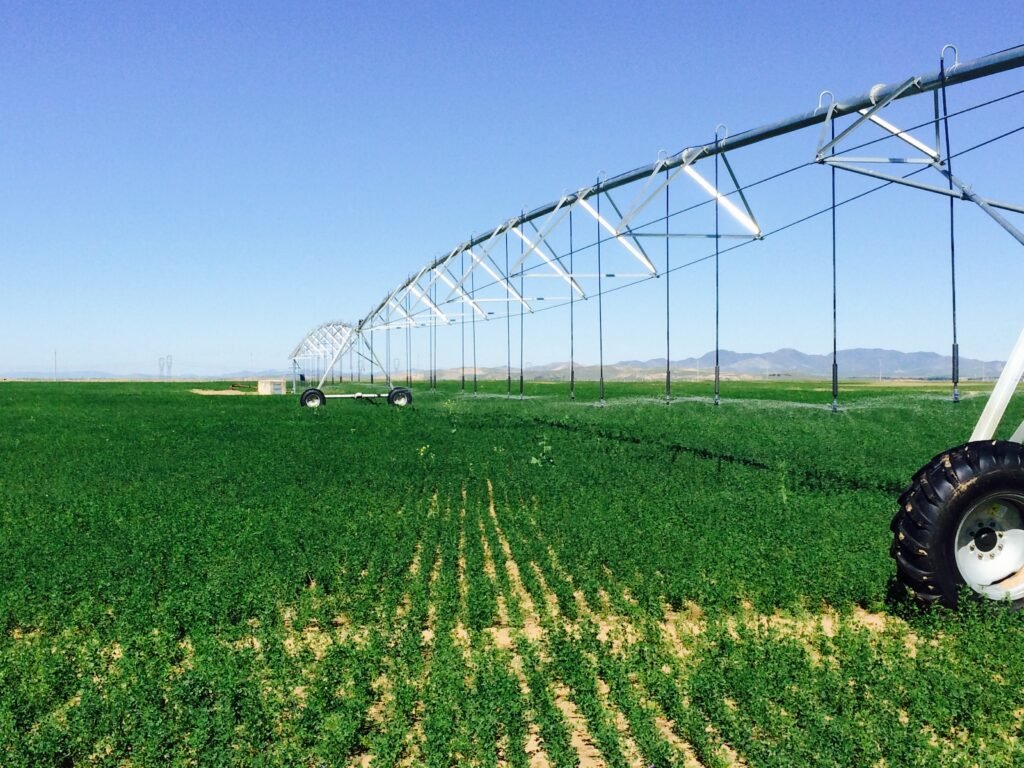
1. Onions, Garlic & Alliums: Protecting Shallow Roots and Bed Structure
Alliums have shallow, sparse root systems (concentrated in the top $20 \sim 30\text{ cm}$) and are typically grown on raised beds.
- Agronomic Challenge: Heavy water droplets erode soil beds, expose bulbs, and seal the soil surface, causing oxygen starvation in the root zone.
- Aqualine System Configuration:
- Low-Pressure Micro-Spray Packages ($0.7 \sim 1.0\text{ bar}$): Fine droplet rotators prevent soil capping and maintain porous, aerated bed structures.
- Frequent, Light Water Applications: The linear cart is programmed for high travel speeds ($70\% \sim 90\%$) to apply frequent $8 \sim 12\text{ mm}$ passes, keeping the shallow root zone continuously moist without deep percolation losses.
- Zero Edge Shadowing: Linear movement ensures that outer rows on field boundary edges receive the exact same water volume as center rows, ensuring uniform bulb sizing across the entire field.
2. Processing Tomatoes & Peppers: Disease Prevention via LEPA Drops
Solanaceous cash crops require strict canopy moisture management to avoid leaf diseases and fruit rot.
- Agronomic Challenge: Wetting dense foliar canopies increases early/late blight risks, while fluctuating moisture levels trigger blossom-end rot and fruit cracking.
- Aqualine System Configuration:
- LEPA (Low Energy Precision Application) Drop Hoses: Flexible drop hoses lower sprinklers beneath the main leaf canopy ($0.3 \sim 0.5\text{ m}$ above ground), depositing water directly onto the soil surface to keep leaves completely dry.
- High-Precision Fertigation: Injects soluble calcium, potassium, and nitrogen through the main linear pipe, delivering nutrients straight to the active root zone during fruit set and bulk-up.
- Straight-Line Bed Alignment: Linear travel paths align naturally with tractor planting beds, preventing wheel ruts from interfering with raised plant rows.
3. Alfalfa, Clover & Forage Crops: High-Volume Post-Harvest Recovery
Forage crops require rapid, high-volume irrigation immediately following each cutting to restart vegetative growth.
- Agronomic Challenge: Slow watering after cutting delays regrowing cycles, while deep wheel ruts created in wet soil damage harvesting equipment during subsequent cuts.
- Aqualine System Configuration:
- High-Flotation Radial Tires: Wide-profile tires distribute machine weight evenly, eliminating deep tracks in soft, freshly cut forage fields.
- High-Speed Wash Passes: High-speed gearboxes allow the Aqualine cart to execute rapid, light cooling passes right after baling to stimulate new crown shoots without softening the soil sub-base.
- High-Flow Pipeline Sizing: Sized with main pipeline diameters capable of handling flow rates above $200 \sim 350\text{ m}^3/\text{h}$ to meet peak summer evapotranspiration ($\text{ET}_c > 9.0\text{ mm/day}$) across large broadacre blocks.
4. Corn (Maize) & Sweet Corn: High Canopy Clearance & Nitrogen Injection
Tall canopy crops demand adequate physical clearance and late-season nutrient delivery when ground rigs can no longer enter the field.
- Agronomic Challenge: Standard height machines drag against tall tassels, while late-season nitrogen deficiencies restrict kernel fill.
- Aqualine System Configuration:
- High-Clearance Span Options ($3.0 \sim 4.2\text{ m}$ Clearance): Heavy-duty galvanized steel legs elevate the main pipeline to pass smoothly over mature corn canopies without causing stalk lodging.
- Mid-Canopy Regulated Drop Sprinklers: Positions sprinklers below the top tassel line to eliminate wind drift while maintaining complete spray pattern overlap.
- Late-Stage Fertigation: Liquid nitrogen injected directly into the Aqualine cart water supply “spoon-feeds” the crop during critical silking and grain-fill stages.
Crop-Specific Aqualine Linear Configuration Matrix
| Crop Type | Primary Agronomic Goal | Aqualine Machine Configuration | Sprinkler & Pressure Setup |
| Onions & Garlic | Bed protection & shallow root moisture | High-speed travel program + Edge-to-edge coverage | Fine droplet micro-rotators ($0.7 \sim 1.0\text{ bar}$) |
| Tomatoes & Peppers | Leaf disease control & cracking prevention | LEPA drop hoses + Precision fertigation skid | Canopy-submerged drop hoses ($0.7\text{ bar}$) |
| Alfalfa & Forage | Fast post-cutting regrowth & rut elimination | High-flotation tires + High-flow main pipe | High-volume multi-trajectory rotators |
| Corn & Sweet Corn | High canopy clearance & late-stage nitrogen | High-clearance span frames ($3.0\text{ m}+$) | Mid-canopy drops + Pressure regulators ($1.4\text{ bar}$) |
Uniform Yield Across Every Square Meter
By matching the Aqualine Linear Sprinkler’s speed programs, drop hose placements, and pressure regulators to your specific crop rotation, growers can achieve up to 98% field utilization on rectangular parcels while maximizing crop quality and input efficiency.
🚜 Ready to optimize your rectangular fields with an Aqualine Linear system?
Contact our technical engineering team with your crop rotation plan, field CAD layout, and water source parameters for a customized system proposal!