
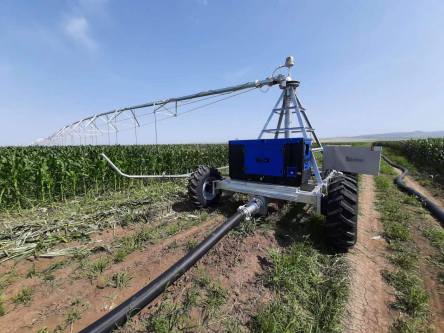
In commercial agriculture, field geometry plays a decisive role in selecting irrigation infrastructure. While center pivots excel in circular fields, rectangular and square land parcels are best served by Aqualine Linear Sprinklers (Lateral Move Systems). Moving in a continuous straight line across the field, an Aqualine linear system irrigates up to 98% of total field acreage, eliminating dry corners and maximizing land utilization.
However, achieving peak crop yields requires aligning the system’s hydraulic design with the maximum daily crop water demand (Evapotranspiration, or $\text{ET}_c$). Below is an engineering guide to calculating crop water requirements and configuring the Aqualine Linear Sprinkler to deliver precise moisture management.
1. Calculating Peak Crop Water Requirements ($\text{ET}_c$)
Crop water requirement varies across growth stages and regional climatic conditions. It is calculated using the standard FAO evapotranspiration formula:
$$\text{ET}_c = \text{ET}_0 \times K_c$$
- $\text{ET}_0$ (Reference Evapotranspiration): The potential atmospheric water loss based on temperature, wind speed, humidity, and solar radiation.
- $K_c$ (Crop Coefficient): Adjusts for canopy density and leaf surface area. During peak bloom, pod filling, or tuber bulk-up, $K_c$ typically reaches 1.1 to 1.25.
In arid or warm agricultural zones, peak daily crop water demand ($\text{ET}_c$) often ranges between 7.0 mm/day and 10.0 mm/day.
2. Linear vs. Pivot Hydraulics: Uniform Application Across the Span
Unlike a center pivot—where outer drive towers travel much faster than inner spans—an Aqualine Linear Sprinkler moves at a uniform speed along its entire length.
This fundamental mechanical difference creates major hydraulic advantages for crop water management:
- Identical Nozzle Orifice Sizes: Because every meter of the main pipeline moves across the field at the exact same ground speed, nozzle sizes remain consistent along the span (unlike the progressively larger nozzles required on pivot outer spans).
- Lower Instantaneous Application Rate: Water is applied at a lower, more gradual rate across the entire field length. This prevents water runoff and soil capping, making linear sprinklers ideal for low-intake clay soils or delicate seedbeds.
- Equal Droplet Dynamics: Every row of crops receives the same droplet kinetic energy, preserving soil structure and preventing crusting around young plant roots.
3. Sizing Aqualine Flow Capacity for Peak Water Needs
To prevent crop stress during peak growth stages, the system’s total flow capacity ($Q$, in $\text{m}^3/\text{h}$) must be calculated based on total field area ($A$), peak daily crop demand ($\text{ET}_c$), daily operating hours ($H$), and application efficiency ($\mathbf{E}_a$):
$$Q = \frac{10 \times A \times \text{ET}_c}{H \times \mathbf{E}_a}$$
- High Application Efficiency ($\mathbf{E}_a = 85\% \sim 95\%$): Equipped with low-pressure drop hoses and LEPA/LESA spray packages ($0.7 \sim 1.4\text{ bar}$), Aqualine linear sprinklers minimize evaporation losses and wind drift.
- Continuous Towing / Guidance Systems: Whether fed by a flexible drag hose or an open canal ditch-feed system, the Aqualine cart maintains accurate alignment via GPS or underground cable guidance, ensuring continuous, automated operation.
4. Peak Crop Water Demand & Linear Configuration Guide
| Crop Type | Peak Demand Stage | Peak Water Need (ETc) | Aqualine System Application Strategy |
| Potatoes / Root Crops | Tuber Bulk-Up | $6.5 \sim 8.5\text{ mm/day}$ | Frequent, light applications ($10 \sim 15\text{ mm}$) to maintain steady topsoil moisture and prevent tuber malformation. |
| Corn / Maize | Tasseling to Silking | $7.5 \sim 9.5\text{ mm/day}$ | High-clearance span structure with mid-canopy drop rotators to ensure deep root-zone recharge. |
| Vegetables & Salad Crops | Canopy Closure | $5.5 \sim 7.5\text{ mm/day}$ | Ultra-low pressure sprinklers ($0.7\text{ bar}$) with fine droplet rotators to protect delicate foliage and prevent bed erosion. |
| Alfalfa / Forage | Pre-Cutting Vegetative | $8.0 \sim 10.5\text{ mm/day}$ | High-speed linear travel passes immediately post-cutting to spur re-growth without creating surface mud. |
5. Travel Speed Programming for Precision Dosing
The travel speed of the Aqualine linear cart directly controls the application depth ($\text{mm}$) applied per pass:
- Fast Pass ($80\% \sim 100\%$ Speed): Applies light watering ($5 \sim 10\text{ mm}$) for canopy cooling, chemical activation, or germinating delicate seeds.
- Slow Pass ($20\% \sim 40\%$ Speed): Applies deep irrigation ($25 \sim 35\text{ mm}$) during peak $K_c$ growth phases to thoroughly recharge the root zone profile.
Maximize Rectangular Field Productivity
By matching the Aqualine Linear Sprinkler’s flow capacity and travel speed to your crop’s peak evapotranspiration rates, growers can maximize yield per hectare while achieving up to 98% field coverage on square and rectangular parcels.
🚜 Planning an irrigation system for rectangular or square land parcels?
Contact our technical engineering team with your field dimensions, water source parameters, and crop types to receive a customized Aqualine Linear system layout and hydraulic head-loss report!