
In commercial agriculture, designing an efficient Center Pivot Irrigation System requires calculating the maximum daily crop water demand during peak growth stages. If a center pivot’s system capacity ($L/\text{s}$ or $\text{m}^3/\text{h}$) fails to match peak evapotranspiration ($\text{ET}_c$) rates, crops experience yield-limiting water stress. Conversely, over-designing system capacity leads to excessive pump energy consumption and unnecessary capital equipment costs.
Understanding how crop water requirements ($\text{ET}_c$) are calculated—and how they dictate center pivot nozzle sizing, system flow rates, and rotation speed programs—is critical to maximizing yield per millimeter of water applied.
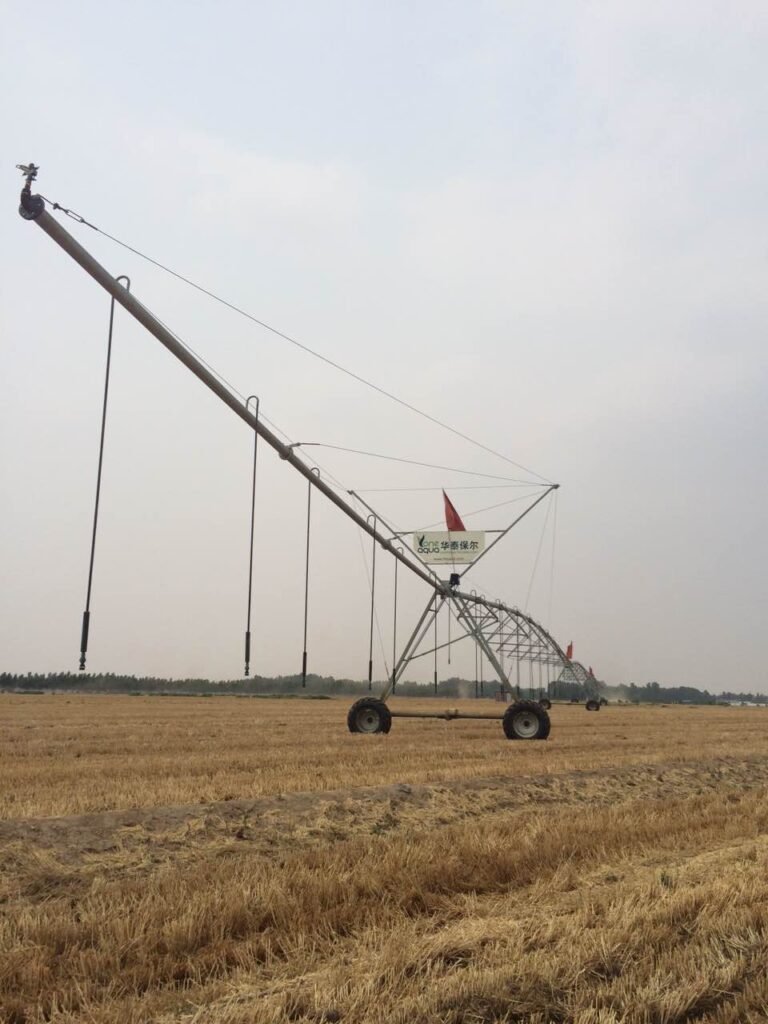
1. Understanding Crop Evapotranspiration ($\text{ET}_c$)
Crop water requirement is governed by local climate conditions and crop growth stage, expressed by the standard FAO equation:
$$\text{ET}_c = \text{ET}_0 \times K_c$$
- $\text{ET}_0$ (Reference Evapotranspiration): The atmospheric water demand based on temperature, solar radiation, humidity, and wind speed.
- $K_c$ (Crop Coefficient): A plant-specific multiplier that adjusts for canopy size, leaf area index, and growth stage.
During early vegetative growth, $K_c$ values are low ($0.3 \sim 0.5$). However, during peak reproductive stages—such as corn tasseling, soybean pod filling, or potato tuber initiation—$K_c$ peaks between $1.1 \text{ and } 1.2$. In arid or hot agricultural zones, daily peak $\text{ET}_c$ can reach $7 \sim 10\text{ mm/day}$.
2. Calculating Required System Gross Application Capacity
To prevent soil moisture depletion during peak $\text{ET}_c$ periods, the center pivot must be engineered with sufficient flow capacity. System capacity ($Q$) is calculated using field area ($A$), peak daily crop demand ($\text{ET}_c$), operating hours per day, and application efficiency ($\mathbf{E}_a$):
$$Q = \frac{10 \times A \times \text{ET}_c}{H \times \mathbf{E}_a}$$
- $Q$: Required system flow rate ($\text{m}^3/\text{h}$)
- $A$: Field area in hectares ($\text{ha}$)
- $\text{ET}_c$: Peak daily crop water requirement ($\text{mm/day}$)
- $H$: Target daily operating hours (typically $20 \sim 22\text{ hours/day}$ to allow for operational maintenance)
- $\mathbf{E}_a$: Application efficiency (typically $85\% \sim 95\%$ for drop-hose LEPA/LESA center pivots)
3. Crop Water Requirement Profiles Across Major Crops
Different crops exhibit distinct peak water demand curves throughout the growing season:
| Crop Type | Peak Demand Period | Peak Daily Water Need (ETc) | Minimum System Gross Capacity |
| Corn / Maize | Tasseling to Silking | $7.5 \sim 9.5\text{ mm/day}$ | $0.8 \sim 1.0\text{ L/s/ha}$ ($6.8 \sim 8.6\text{ m}^3/\text{h/ha}$) |
| Potatoes | Tuber Initiation & Bulk | $6.0 \sim 8.0\text{ mm/day}$ | $0.7 \sim 0.9\text{ L/s/ha}$ ($6.0 \sim 7.8\text{ m}^3/\text{h/ha}$) |
| Alfalfa / Forage | Pre-Harvest Vegetative | $8.0 \sim 10.5\text{ mm/day}$ | $0.9 \sim 1.1\text{ L/s/ha}$ ($7.8 \sim 9.5\text{ m}^3/\text{h/ha}$) |
| Wheat / Small Grains | Booting to Heading | $5.5 \sim 7.5\text{ mm/day}$ | $0.6 \sim 0.8\text{ L/s/ha}$ ($5.2 \sim 6.9\text{ m}^3/\text{h/ha}$) |
| Sugarcane | Grand Growth Phase | $8.5 \sim 11.0\text{ mm/day}$ | $1.0 \sim 1.2\text{ L/s/ha}$ ($8.6 \sim 10.4\text{ m}^3/\text{h/ha}$) |
4. Hydraulic & Nozzle Package Configuration for Water Demand
Once peak crop water requirements are established, center pivot components must be configured to deliver water accurately without destroying soil structure:
- Graduated Nozzle Packages: Outer spans travel much faster than inner spans. Nozzle orifice sizes must be progressively increased from the pivot tower outward, ensuring that every square meter receives the exact application depth required by the crop.
- Inline Pressure Regulators ($0.7 \sim 1.4\text{ bar}$): Regulators fitted above each drop-hose maintain constant pressure at every nozzle despite elevation variations, guaranteeing high water application uniformity ($\text{UC} > 90\%$) across fluctuating topographies.
- Variable Rotation Speed Control: Modern control panels allow operators to adjust rotation speed percentage. During early growth stages, fast rotation cycles apply light application depths ($5 \sim 10\text{ mm}$) to warm the soil; during peak growth stages, slower cycles apply deeper irrigation depth ($20 \sim 35\text{ mm}$) to fully recharge the root zone.
Technical Summary
Designing a center pivot to match peak crop water requirements ensures that crops never enter moisture deficit stress during yield-critical flowering and fruiting stages. Sizing pipeline diameters ($\varnothing 133\text{ mm}$ or $\varnothing 168\text{ mm}$) and nozzle packages around peak $\text{ET}_c$ delivers maximum crop yields while minimizing seasonal pumping and fuel expenses.
🌾 Need a peak water demand calculation for your crop rotation?
Contact our engineering application team with your crop types, local climate data, and field dimensions to receive a custom hydraulic design and nozzle package printout!