
When designing a Center Pivot Irrigation System, matching equipment specifications to the exact size of your land parcel is essential to optimizing both initial capital expenditure and ongoing operational costs. The physical area covered by a center pivot scales exponentially with its radius ($A = \pi r^2$), meaning that larger systems require specialized hydraulic, structural, and drive train engineering to manage high outer-edge rotation speeds and massive water volumes.
Below is an engineering overview for configuring center pivot systems across three common land scale categories: small-to-medium parcels ($10 \sim 30\text{ ha}$), medium-to-large fields ($30 \sim 70\text{ ha}$), and broadacre mega-farms ($70 \sim 120+\text{ ha}$).
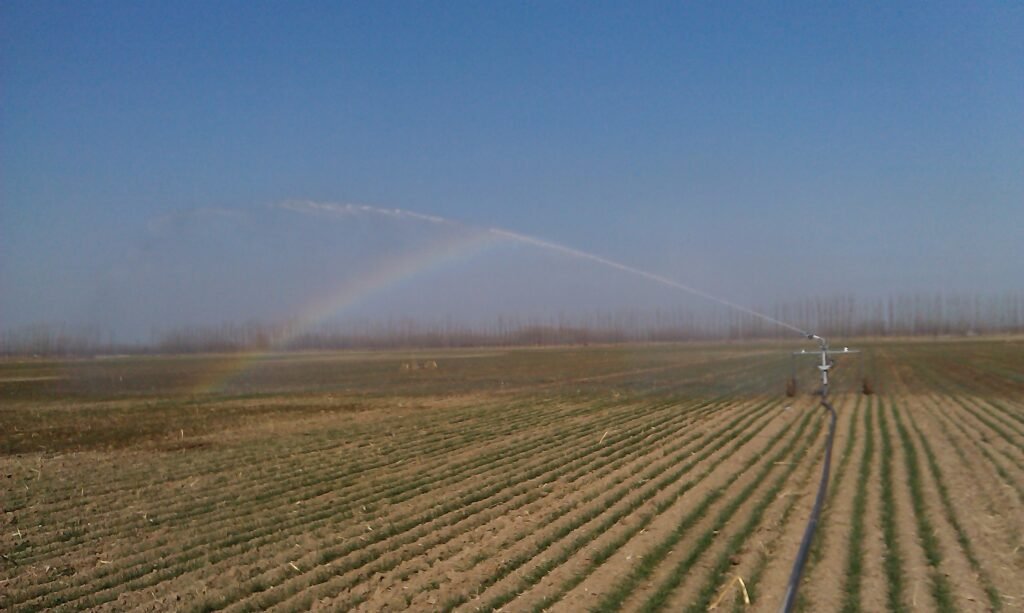
1. Small-to-Medium Parcels (10 to 30 Hectares)
- Typical System Radius: Approximately $180\text{ m} \sim 310\text{ m}$ (3 to 5 spans)
- Core Hydraulic Strategy:
- Pipeline Sizing: A $\varnothing 133\text{ mm}$ ($5\text{ inches}$) main pipeline is ideal for these flow rates ($50 \sim 130\text{ m}^3/\text{h}$), providing optimal fluid velocity without unnecessary structural weight or cost.
- Pumping Pressure: Requires lower inlet connection pressure ($2.0 \sim 2.8\text{ bar}$), making these configurations ideal for lower-capacity wells or surface water pumps.
- Agronomic Advantages: Highly flexible and suited for smaller, irregular fields, seed production plots, and high-value vegetable crops. Compact span designs handle rolling hills and moderate slopes up to $\pm15\%$ with minimal stress on span joints.
2. Medium-to-Large Fields (30 to 70 Hectares)
- Typical System Radius: Approximately $310\text{ m} \sim 470\text{ m}$ (6 to 8 spans)
- Core Hydraulic Strategy:
- Pipeline Sizing: A $\varnothing 168\text{ mm}$ ($6\ 5/8\text{ inches}$) main pipeline is required to handle flow rates ranging from $130\text{ m}^3/\text{h}$ to $280\text{ m}^3/\text{h}$. The larger internal diameter limits friction head loss over long pipe distances, maintaining pump efficiency.
- Sprinkler Package Sizing: Outer spans cover significantly more area per revolution than inner spans. Graduated nozzle packages with pressure regulators ($0.7 \sim 1.4\text{ bar}$) are required to prevent over-watering near the central pivot tower and under-watering at the outer towers.
- Agronomic Advantages: Represents the industry sweet spot for commercial grain crops (corn, wheat, soybeans) and forage operations (alfalfa), delivering high labor automation and rapid return on investment (ROI).
3. Broadacre Mega-Farms (70 to 120+ Hectares)
- Typical System Radius: $470\text{ m} \sim 620+\text{ m}$ (9 to 12+ spans)
- Core Hydraulic Strategy:
- Pipeline Sizing: Requires heavy-duty $\varnothing 168\text{ mm}$ ($6\ 5/8\text{ inches}$) or $\varnothing 219\text{ mm}$ ($8\ 5/8\text{ inches}$) main pipelines to support heavy continuous flow rates ($300 \sim 500+\text{ m}^3/\text{h}$).
- High-Speed Drive Trains & Flotation: The outermost drive towers must travel at significantly faster ground speeds to complete a full revolution in a reasonable timeframe. High-torque gearboxes and wide, high-flotation tires are necessary to maintain traction and prevent deep wheel ruts.
- End Gun & Overhang Integration: Adding a $25\text{ m} \sim 30\text{ m}$ overhang with an automated booster pump and end gun adds an additional $5 \sim 10\text{ hectares}$ of coverage without requiring an additional motorized wheel tower.
- Agronomic Advantages: Maximizes land-use efficiency for large corporate agricultural projects, allowing a single operator to manage hundreds of hectares remotely via smart control panels.
Hectare Sizing & Engineering Comparison Matrix
| Coverage Area | System Radius | Recommended Pipe Size | Typical System Flow Rate | Primary Design Focus |
| 10 – 30 Hectares | $180\text{ m} \sim 310\text{ m}$ | $\varnothing 133\text{ mm}$ ($5″$) | $50 \sim 130\text{ m}^3/\text{h}$ | Lower capital cost, adaptable to smaller or undulating fields |
| 30 – 70 Hectares | $310\text{ m} \sim 470\text{ m}$ | $\varnothing 168\text{ mm}$ ($6\ 5/8″$) | $130 \sim 280\text{ m}^3/\text{h}$ | Optimal balance of friction head loss, energy use, and acreage |
| 70 – 120+ Hectares | $470\text{ m} \sim 620+\text{ m}$ | $\varnothing 168\text{ mm}$ or $\varnothing 219\text{ mm}$ | $300 \sim 500+\text{ m}^3/\text{h}$ | Maximum broadacre coverage, heavy-duty drive trains & high flotation |
Optimize Your Field Layout
Sizing a center pivot correctly requires calculating total dynamic head, water availability, and field geometry. Matching the pipeline diameter and span configuration to your specific hectare target ensures maximum application efficiency and lower long-term pumping expenses.
🚜 Planning an irrigation layout for your land parcel?
Contact our technical engineering team with your parcel dimensions or CAD files to receive a customized field coverage map, hydraulic calculation, and equipment proposal!