
In large-scale agricultural production, field layout and water efficiency dictate overall farm profitability. While traditional overhead irrigation systems offer automated watering, square and rectangular fields often present a challenge: circular spray patterns leave un-irrigated corners, leading to wasted acreage and reduced crop yields.
The linear move irrigation system (also known as a lateral move irrigator) addresses this limitation by moving continuously in a straight line across rectangular or square plots. By delivering uniform water application across 100% of the field area, linear systems provide an optimal balance of land utilization, precise water placement, and long-term return on investment (ROI).
This buyer’s guide explores the operational advantages, system configurations, guidance technologies, and selection criteria for linear move irrigation equipment.
1. Core Advantages of Linear Irrigation Systems for Commercial Farms
Linear move irrigation systems are engineered specifically for straight-line field geometries, offering distinct operational benefits for modern agricultural operations.
100% Rectangular Field Coverage
Unlike center pivots that irrigate in a circle and leave up to 22% of a square field unirrigated, a linear move system travels back and forth along the full length of a rectangular plot. This maximizes cultivated land area and ensures equal crop yields across the entire field without leaving dry corners.
Exceptional Water & Energy Savings
Linear systems operate using low-pressure drop-down sprinklers and precision spray nozzles. Operating at lower inlet pressures compared to traditional high-pressure rain guns, they significantly reduce energy and fuel consumption while minimizing water loss from evaporation and wind drift.
High Application Uniformity
Water is distributed evenly across every meter of the pipeline span. Controlled movement speeds and constant operating pressure prevent localized over-watering, soil compaction, and runoff, fostering uniform root development and consistent crop emergence.
2. Key System Types: Hose Feed vs. Ditch Feed Systems
The choice of water supply configuration depends on field layout, infrastructure availability, and flow volume requirements.
Hose Feed (PE Pipe) Systems
Hose feed linear systems draw water through a heavy-duty, flexible polyethylene (PE) drag hose connected to pressurized underground hydrants positioned along the travel path.
- Best Suited For: Small-to-medium field widths, farms with existing underground mainlines, or fields requiring high mobility.
- Operational Feature: The system automatically pulls and manages the drag hose, requiring periodic repositioning or automated double-hose switching at hydrant nodes.
Ditch Feed (Canal Pull) Systems
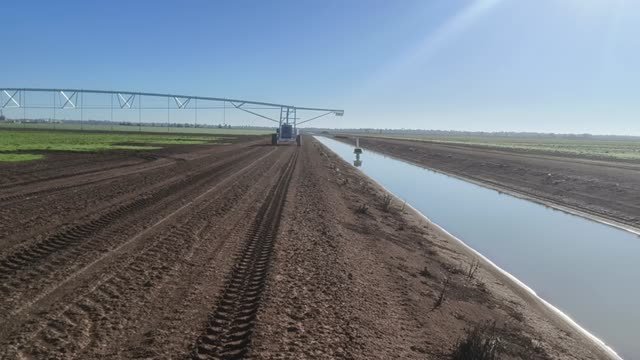
Ditch feed linear systems draw water directly from an open, continuous concrete canal or ditch running parallel to the machine’s travel path via an onboard diesel engine pump unit or floating suction intake.
- Best Suited For: Large-scale commercial fields with high flow rate requirements ($m^3/h$) where installing underground piping is impractical.
- Operational Feature: Provides continuous, uninterrupted water delivery over long field runs without the need to stop and switch hydrants.
3. Guidance Systems for Precise Linear Alignment
Maintaining a precise, straight-line trajectory across hundreds of meters is essential to prevent structural stress and pipeline deviation.
- Below-Ground Cable Guidance: An inductive antenna detects a low-voltage signal emitted from a buried cable along the field edge, offering reliable, weather-proof auto-steering.
- Above-Ground Furrow or Cable Guidance: Uses mechanical guide wheels running in a pre-dug furrow or tracking a taut steel cable along the field boundary.
- GPS / RTK Automated Guidance: Employs satellite positioning for high-precision, contactless navigation, eliminating physical ground cables and allowing flexible field path programming.
4. Key Evaluation Criteria Before Purchasing
Before selecting a linear move system, farm managers and technical engineers should evaluate the following parameters:
- Field Geometry & Slope: Field length-to-width ratios, terrain slope changes, and physical boundary obstacles.
- Water Source Placement: Center-feed vs. end-feed layouts to determine drag-hose length or canal position.
- Power Access: Onboard diesel generator sets vs. trailing electric cable systems.
- Soil Infiltration Rate: Matching nozzle packages and drop-tube heights to soil intake capacity to prevent surface ponding.
Maximize Your Field Efficiency with HT Bauer
HT Bauer engineers industrial-grade linear move irrigation systems built for structural strength, high water uniformity, and low operational maintenance. Our engineering team provides custom field layout designs, hydraulic calculations, and equipment configurations tailored to your specific agricultural requirements.
Contact our international sales team today to consult with an irrigation specialist or request a custom proposal.
- Website: HT Bauer Official Site
- Email: sunlei@htbauer.com
- Inquire Now: Request a custom layout design and technical quotation.